
This post is also available in: Tiếng Việt (Vietnamese)
Mastering unmanned aerial vehicle (UAV) technology means achieving autonomy in airspace and national defense capabilities, aligned with the spirit of self-reliance and self-strengthening of the nation. Countries around the world are moving rapidly and decisively in this field. If Vietnam falls behind, the risk of lagging in this strategic industry will become increasingly evident.
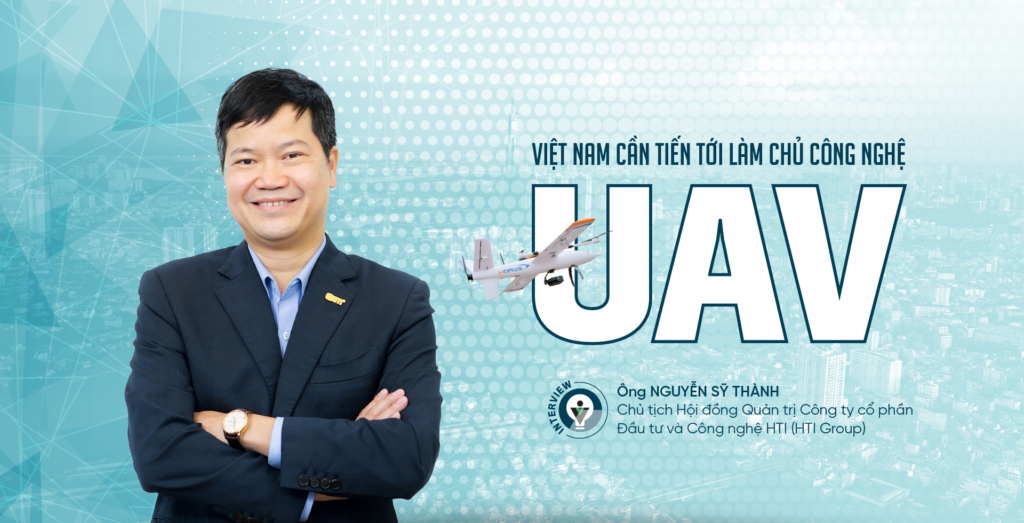
In an interview with Vietnam Economic Times / VnEconomy, Mr. Nguyen Sy Thanh, Chairman of the Board of Directors of HTI Investment and Technology Joint Stock Company (HTI Group), emphasized that the low-altitude economy is an entirely new ecosystem with enormous potential and strong spillover effects capable of driving growth across multiple sectors — from agriculture and logistics to security and defense. However, for the industry to truly develop, it requires time, clear policies, and synchronized participation from businesses across the ecosystem.
A New Economic Ecosystem
[Reporter:] The low-altitude economy is increasingly regarded by many countries as a new growth frontier. In Vietnam, the concept has also begun attracting attention. How do you assess Vietnam’s opportunities and advantages in this emerging economic space?
“I believe the low-altitude economy will become one of the most important growth spaces in the coming years. When people talk about the low-altitude economy, many only think about flying vehicles. In reality, however, it is a completely new economic ecosystem that includes aircraft, operational infrastructure, flight management systems, data, software, mission services, maintenance, training, and supporting industries.
For Vietnam, the opportunities are very clear. We possess diverse terrain and strong demand in sectors such as infrastructure monitoring, agriculture, forestry, search and rescue, security, specialized logistics, and field digital transformation. These are all areas where UAVs can create significant advantages in terms of cost, operational speed, and data quality.
Vietnam also has strengths in its young technical workforce, rapid adaptability to new technologies, and a sufficiently large domestic market before expanding internationally.
However, the greatest advantage lies not only in market demand, but in our ability to proactively build technological capabilities and a supporting ecosystem. If done well, the low-altitude economy will not only create new products but also entirely new value chains.
At HTI, we do not view UAVs as standalone products. Instead, we are developing integrated systems that combine aircraft platforms, payloads, ground control stations, management software, mission data systems, and customized integration capabilities for different application scenarios. This is a critical advantage because future markets will not simply purchase UAVs — they will demand complete, operable, maintainable solutions capable of delivering real-world value.”
UAVs and the Future of Economic Growth
[Reporter:] The low-altitude economy, with UAVs playing a central role, is considered one of the potential drivers contributing to Vietnam’s double-digit economic growth over the next decade. In terms of market scale and strategic importance, how do you evaluate its role in an era where science, technology, and innovation are becoming the primary drivers of growth?
“Vietnam’s economy is currently valued at over USD 500 billion, while the low-altitude economy is projected to reach approximately USD 10 billion by 2030. Therefore, its direct contribution may still appear relatively modest.
However, the development of UAV technology can stimulate and transform many other sectors by optimizing resources, reducing labor dependency, and improving productivity across industries. If viewed as an isolated sector, its impact may seem limited, but when considered within the broader economic landscape, it becomes an extremely promising growth space.
It is also important to understand that the low-altitude economy is not limited to aircraft themselves. It is fundamentally a new economic ecosystem encompassing aircraft systems, operational infrastructure, flight management systems, software, mission services, maintenance, training, and supporting industries.
For example, in logistics — especially in mountainous or difficult terrains — UAV advantages become particularly evident. A 10-kilometer forest route that traditionally takes hours to travel can be reduced to just minutes using UAVs.
Similarly, in high-rise buildings where specialized vehicles struggle to access upper floors, UAVs can rapidly operate at heights of 30, 50, or even 100 stories, opening possibilities for aerial firefighting and emergency rescue support.
UAVs can generate significant improvements in cost efficiency, operational speed, and data quality across numerous sectors. Combined with Vietnam’s young technical talent and rapid technology adoption, the low-altitude economy has the potential not only to create new products but also entirely new value chains.”
Five Years of Investment — Still No Profit
[Reporter:] HTI is recognized as one of the early pioneers in Vietnam’s UAV industry and among the few domestic companies manufacturing UAVs independently. Has HTI become profitable in the UAV sector yet?
“We began researching and developing UAVs in 2020. At that time, manufacturing UAVs in Vietnam still seemed like a distant ambition. Fortunately, HTI was representing and exclusively distributing products from several world-leading technology companies in the industry, giving our team opportunities to receive advanced training and exposure to modern technologies ranging from design, aerodynamics, mechanics, software development, to UAV integration.
Back then, there were already companies producing drones, but most focused on commercial drones. HTI chose a different direction by concentrating on VTOL (Vertical Take-Off and Landing) aircraft because we wanted differentiation and also needed to solve practical operational challenges.
It took us nearly three years of research and testing before we successfully developed our product. Once we gradually mastered aerodynamics, signal transmission, image analysis, and other core technologies, we became confident enough to experiment with advanced materials such as fiber optics and composites.
A major milestone came when HTI conducted flight demonstrations with law enforcement agencies in Bac Ninh Province. The UAV achieved operational ranges exceeding 30 kilometers, flight durations of around 150 minutes while still retaining backup battery capacity, stable signal transmission, and high-quality imaging. That was the moment our leadership team and R&D engineers truly gained confidence in the product and recognized that we had mastered the technology.
Despite these achievements, HTI is still operating at a loss in the UAV sector. In R&D, failure is far more common than success. We fully understand that research and development cannot generate quick returns.”
Toward Technological Self-Reliance
[Reporter:] At Vietnam International Digital Week 2025, HTI introduced the Horus P02 VTOL reconnaissance UAV featuring AI-powered target detection and high-resolution imaging, while announcing a localization rate of approximately 80%. What does this 80% localization rate actually represent? And do you believe Vietnam can eventually produce fully localized UAVs?
“Localization should not only be understood from the perspective of materials and components. It must also be evaluated in terms of technical capability, development processes, and the ability to independently improve products.
For example, Boeing aircraft contain millions of components sourced globally, yet nobody questions them as American products. True mastery means controlling the design, integration, manufacturing, and optimization processes domestically.
At HTI, we have already mastered the overall UAV platform design, airframe structures, mechanical systems, integration systems, and software development. Therefore, we are fully capable of designing synchronized systems tailored to practical applications rather than simply assembling pre-existing modules.
Of course, we also realistically acknowledge that certain components — especially advanced electronic parts, specialized sensors, high-tech materials, and microelectronics — still depend on foreign supply chains. This is a common challenge for technology companies developing complex systems.
Our strategy is clear: maximize domestic design and manufacturing where possible, while proactively integrating, quality-controlling, and gradually replacing imported technologies over time.
We strongly hope to see a broader domestic industrial ecosystem develop around UAV manufacturing. In today’s increasingly fragmented global environment, mastering products and domestic manufacturing capabilities is critically important. If Vietnamese enterprises collaborate effectively within the ecosystem, achieving fully localized UAV products is absolutely feasible.”
UAVs and National Defense
[Reporter:] With recent global conflicts, UAVs are increasingly viewed not merely as part of the low-altitude economy but as critical components of modern defense capabilities. What is your perspective on this trend?
“At recent defense exhibitions, traditional weapons such as firearms were no longer the primary focus. Instead, reconnaissance UAVs, loitering munitions, stealth UAVs, and anti-radar systems attracted tremendous attention.
Fundamentally, UAVs are payload platforms. Once you master the technology, what you choose to carry becomes entirely your decision — cameras, radar systems, sensors, or other specialized equipment depending on operational objectives.
Therefore, mastering UAV technology means achieving sovereignty over airspace and defense capabilities, fully aligned with the spirit of national self-reliance and resilience. This is an extremely important issue, and Vietnam must master this technology.
Defense demand in this field will be enormous and difficult to quantify. Countries worldwide are advancing rapidly and aggressively. If Vietnam moves too slowly, the risk of falling behind is very real.
However, accelerating development is not simple due to limitations in technology, materials, and human resources. That is why strong policy support is urgently needed.”
A clear, stable, and predictable policy framework is essential
[Reporter:] In recent years, amid ongoing global conflicts, UAVs are increasingly viewed not merely as part of the low-altitude economy, but as a key component of modern defense capabilities. What is your perspective on this direction?
“At recent defense exhibitions, traditional weapons such as firearms are no longer the main focus. Instead, reconnaissance UAVs, loitering munitions, stealth UAVs, anti-radar systems, and related technologies have attracted tremendous attention.
Fundamentally, a UAV is a payload platform. Once you master the technology, what it carries is entirely up to you — it can be cameras, radar systems, sensors, or other specialized equipment depending on operational requirements.
Therefore, mastering UAV technology means achieving autonomy in airspace and national defense capabilities, aligned with the spirit of national self-reliance and resilience. This is an extremely important issue, and it is essential that Vietnam masters this technology.
Demand in the defense sector will be enormous, perhaps even difficult to quantify, and it requires early preparation in terms of technological capability. Countries around the world are moving very quickly and decisively in this field. If Vietnam moves too slowly, the risk of falling behind is very real.
However, accelerating development is not simple due to existing limitations in technology, materials, and human resources. Therefore, the market urgently needs a strong policy-driven push.”
[Reporter:] Specifically, what kinds of policies are needed?
“UAVs represent a highly integrated technology sector involving airspace management, technical standards, safety regulations, data systems, industrial manufacturing, supply chains, workforce training, and application markets. Therefore, if this field is to contribute meaningfully to national economic growth, we need a synchronized development ecosystem.
In my opinion, the first requirement is a clear, stable, and predictable policy framework. Businesses can only make long-term investments when they clearly understand how the market will operate — including testing procedures, licensing, operations, and commercialization processes. If regulations remain fragmented or unpredictable, it becomes very difficult to attract major investments in a new industry.
Second, there needs to be controlled testing mechanisms for new technologies and operational models. UAVs cannot develop if companies are limited to laboratory research without opportunities for flight testing, verification, integration, and evaluation in real-world scenarios. We need testing zones, sandbox mechanisms, and sufficiently flexible legal frameworks that allow businesses to innovate while still ensuring safety and regulatory oversight.
Third, the industry needs an initial market-driving mechanism. For strategic technologies, the early market is extremely important. If there are procurement programs, pilot projects, or preferential policies encouraging the use of domestically developed products in suitable applications, businesses will have opportunities to refine technologies, improve product quality, and build genuine competitiveness.
Fourth, it is necessary to develop supporting industries and human resources. Building UAVs does not only require aerospace engineers — it also requires expertise in precision mechanics, electronics, control systems, software, data, materials, prototyping, testing, certification, and after-sales services.
From HTI’s perspective, our workforce demand will grow significantly in the coming years. However, recruiting qualified UAV engineers today remains very difficult. In most cases, companies still have to train personnel internally because formal training programs are still limited.
Fifth, UAVs should not simply be viewed as technology products, but as an entirely new economic sector. With this perspective, discussions will go beyond aircraft themselves and focus on value chains, data, services, infrastructure, and national industrial capabilities. If approached this way, UAVs can absolutely become a meaningful contributor to economic growth in the coming years.”
[Reporter:] Among the five policy recommendations you mentioned, if you had to choose the most urgent one — the policy capable of creating immediate impact for Vietnamese UAV companies, including HTI — what would it be?
“For businesses, early procurement and production-order mechanisms are extremely important. However, in the immediate future, the most urgent need is probably the establishment of dedicated UAV flight-testing zones.
This issue has been discussed for quite some time, but there is still no clear planning or implementation. In reality, we often have to travel very long distances just to conduct flight tests, which creates considerable difficulties for research and development activities.
In addition, there should also be policies supporting training programs from universities and research institutes in order to strengthen the industry’s talent pipeline. We are talking about the low-altitude economy as a future growth driver, but the number of engineers and specialists in this field remains very limited. If the industry develops too quickly without sufficient human resources, implementation will become very challenging.
In summary, this is the period when technology enterprises urgently need policy support and long-term nurturing. Resolution 57 has been a tremendous source of encouragement for HTI Group in particular and for Vietnamese technology companies in general.”
[Reporter:] Thank you very much!
Interview conducted by Ngo Huyen & Thuy Dieu – VnEconomy